We use theoretical modeling, computational simulations, and data-driven analysis to uncover how non-equilibrium processes generate hierarchical organization and adaptive mechanical behaviors in soft and living matter systems.
Living cells maintain and remodel their cytoskeleton — a dynamic network of filaments, motors, and crosslinkers — to generate forces, control shape, and transmit mechanical signals. At growth rates exceeding structural relaxation timescales, filament growth itself drives the system far from equilibrium, creating non-equilibrium structures with non-trivial morphological and mechanical properties.
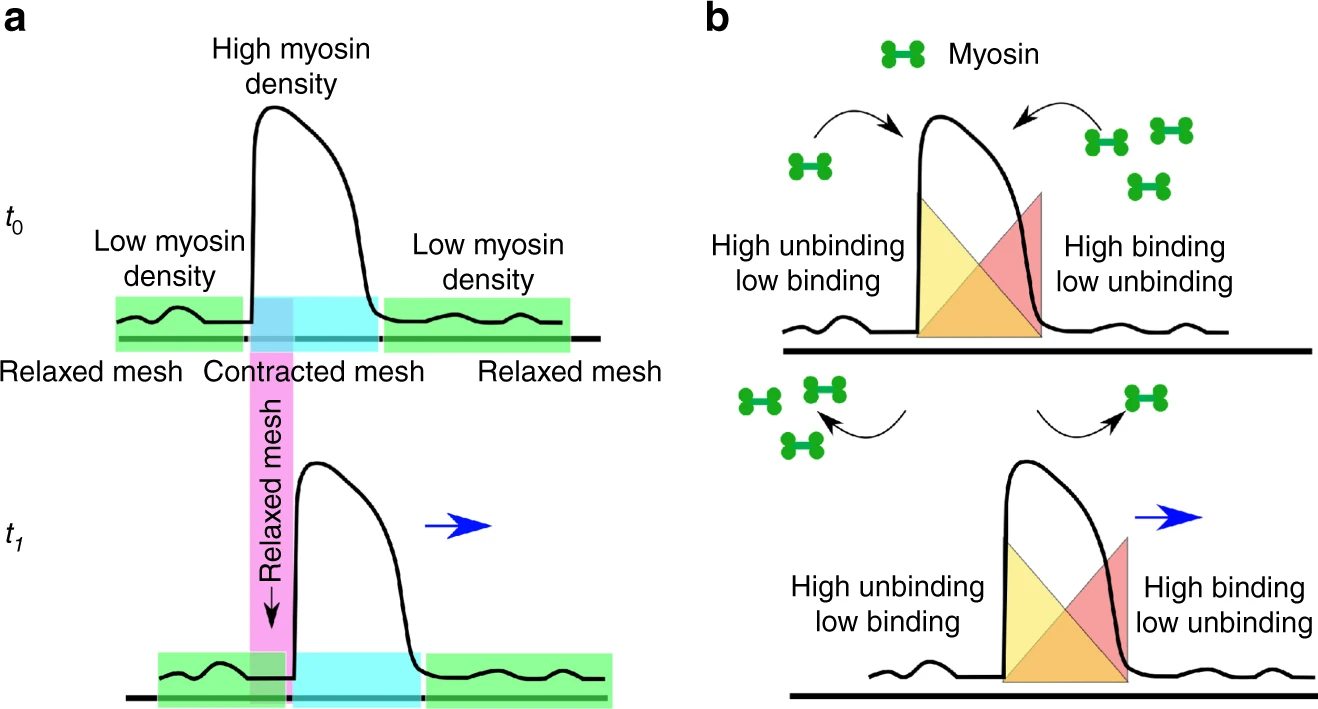
We study how actomyosin turnover generates pulsatile forces during morphogenesis, how F-actin curvature drives topological defect formation, and how membrane-cortex coupling regulates instabilities in biomimetic systems. We develop hydrodynamic and agent-based frameworks that link mesoscopic architecture to emergent mechanics, uncovering predictive principles for living matter from sub-cellular cortex to supra-cellular tissue.
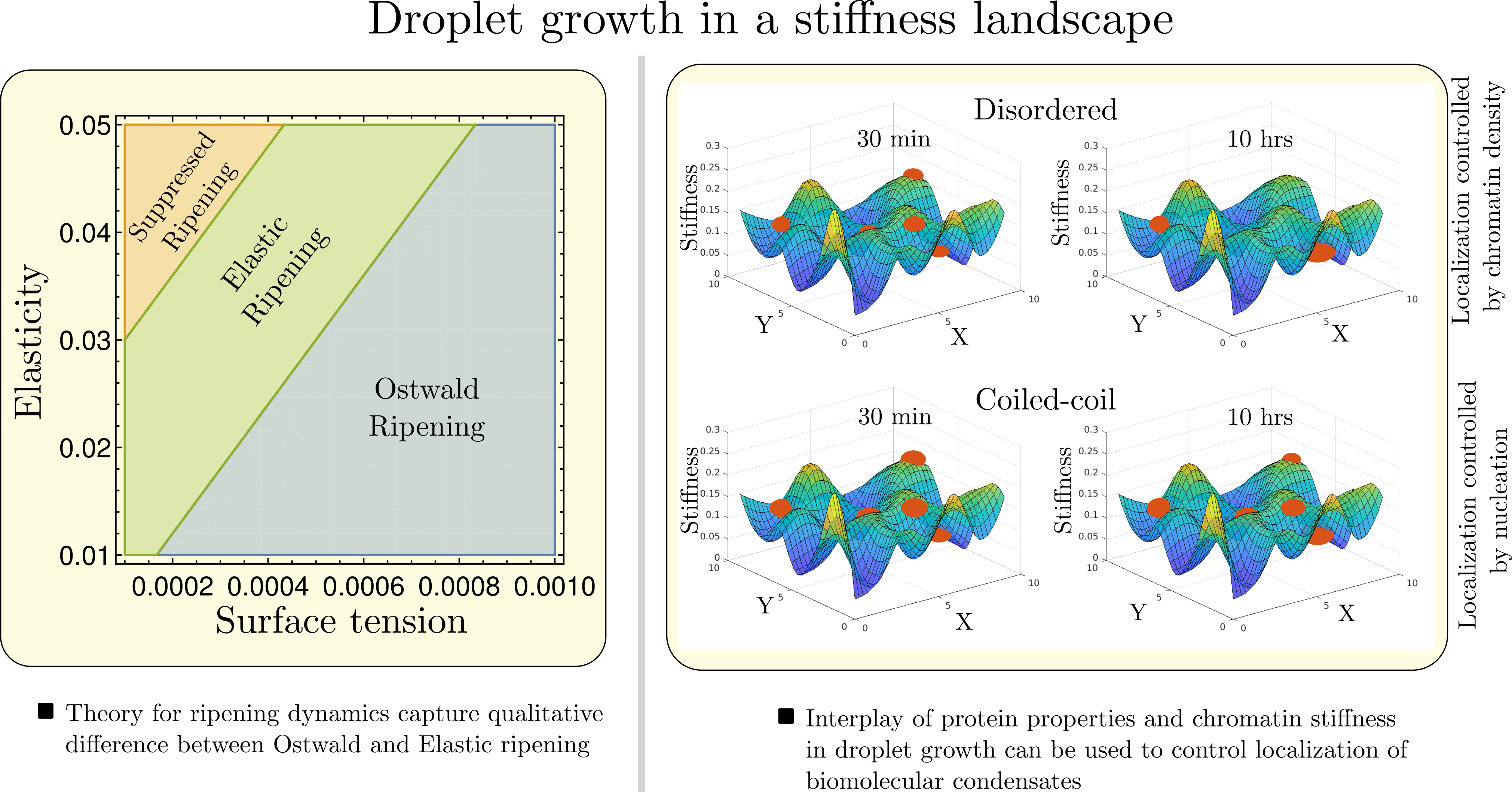
Biomolecular condensates are membraneless compartments formed through liquid-liquid phase separation of proteins and nucleic acids. They serve critical cellular functions from gene transcription to DNA repair. While existing theories describe condensate formation in homogeneous liquids, cells present a dramatically different landscape: mechanically anisotropic, with crosslinked active elastic networks and motor-driven non-equilibrium stresses.
We discovered elastic ripening in chromatin-embedded condensates, showing how embedding network mechanics suppresses classical coarsening. We develop hydrodynamic and agent-based models to reveal how cells harness network heterogeneity and active processes to achieve precise condensate organization — establishing design principles for controlling phase-separated structures in both biological and synthetic systems.
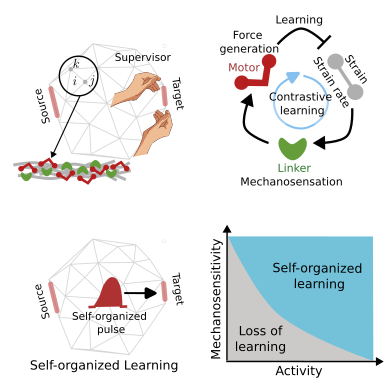
Physical learning is an emerging field demonstrating that materials without nervous systems can adapt their internal interactions autonomously, based on local responses to stimuli, to acquire functionality — a direct analogue to synaptic plasticity in neural networks. While physical learning has been demonstrated in passive systems at mechanical equilibrium, living matter operates far from equilibrium through ATP consumption, molecular motor activity, and continual component turnover.
We recently introduced a framework for physical learning in cytoskeletal networks, showing how mechanochemical feedback enables networks to learn input-output relations through biologically plausible dynamics. We now investigate how non-equilibrium features enhance learning capacity, accelerate adaptation, or enable qualitatively new functionalities — from cytoskeletal networks to epithelial tissues achieving morphogenetic outcomes through decentralized feedback.
Active hydrodynamics, dynamical systems theory, stochastic modeling, chemical master equations
Dynamic Monte Carlo, agent-based molecular dynamics, phase-field simulations, Gillespie algorithm
Machine learning, contrastive learning, deep neural networks, ML-enhanced parameter inference
Coarse-grained hydrodynamics, continuum elasticity, connecting molecular to mesoscale to tissue